How to Build an Emergency Fund on One Income (Even When Money Is Tight)
This post may contain affiliate links. If you click and make a purchase, I may earn a small commission at no extra cost to you. I only recommend tools I genuinely use and believe in.
In a previous post, we shared our thoughts on why we decided to build an emergency and how a single move proved we made the right decision. Today I want to go a bit more in-depth.
Specifically, I want to take a deeper dive into how to build an emergency fund on one income.
In January 2020, Sarah and I got married, moved to Danshui, and started our life together with $2,000 in the bank.
That first month, I made one decision about our money. Not a series of decisions but one. We were going to build a system, and we were going to start it immediately: emergency fund and investments running in parallel, both non-negotiable, both funded before anything optional got a dollar.
The emergency fund came first in the budget order. Not first in time. Both started the same month. But within every month’s income, the floor got funded before the growth did. Needs, then giving and savings, then investing, then whatever was left. That sequence wasn’t arbitrary. It was the reason the whole system held.
We were earning between $1,200 and $1,500 a month from missionary support, variable, faith-based, not always predictable. The idea of saving six months of expenses on that income felt almost laughable. But I had watched people without emergency funds get knocked over by things that were inconvenient, not catastrophic. A car repair. A medical bill. A move they didn’t plan for. The absence of a safety net made ordinary problems into emergencies.
So we built one. Slowly. Consistently. From the first month.
Here is how we built an emergency fund on one income with the real numbers, and the real story of what happened when we actually needed it.
What an Emergency Fund Actually Is (And What It Isn’t)
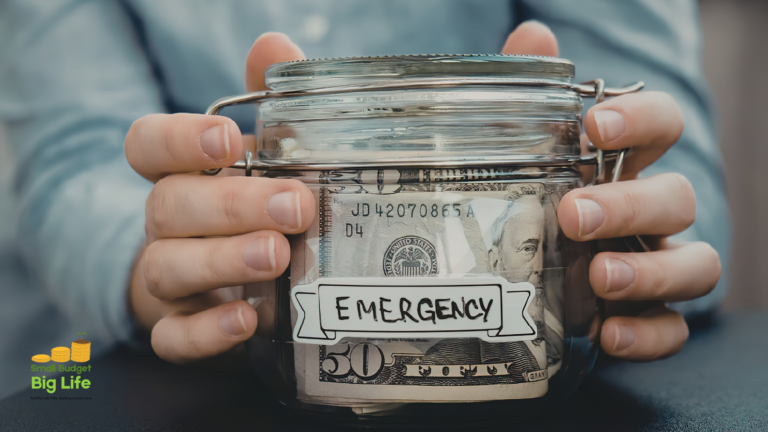
So how do you build an emergency fund? Well, first of all, an emergency fund is not a savings goal. It is not a vacation fund, a car repair fund, or a “we might want new furniture someday” fund. It is a completely separate pool of money whose only job is to protect your family from the events you cannot predict.
Job loss. A medical event. A major repair. A move you didn’t see coming.
It is not for investment. It is not for opportunity. If the stock market drops 30% and you think it is a good time to buy. That is not what this money is for. The emergency fund exists to absorb shocks, not to chase returns.
This distinction matters more than people realize. I have seen families drain their safety net for things that felt urgent but were not emergencies. Once the fund is used for something other than a genuine emergency, rebuilding it requires a discipline that is harder to find when you have already rationalized breaking it once.
Keep it separate. Keep it boring. That is the whole point.
Why Six Months? Where the Number Comes From
The standard advice is three to six months of expenses. Three months if your income is stable; six months if it varies or you are self-employed.
We aimed for six from the start. Not because of the advice, but because our income was not stable. Missionary support fluctuates. Some months donors give more. Some months they give less. Some months someone stops giving without telling you why. You learn to build wider margins.
Six months also had a psychological effect I did not anticipate. Once we had it, I stopped thinking about emergencies. Not in a naive way, I was still cautious, still paying attention. But the low-level background worry that comes from having no cushion went away. That mental space was worth as much as the financial protection.
On our income, six months of expenses meant roughly $7,000 to $9,000. Not a small number. Not a number we reached quickly. But a reachable number and we reached it.
How to Build an Emergency Fund on One Income: Our Personal Method
How We Built Ours on $1,200 a Month
Start with a fixed monthly amount not what’s left over
The most common mistake people make with emergency fund building is treating it as discretionary. Whatever is left at the end of the month goes into savings. The problem is that nothing is ever left at the end of the month when savings is optional.
From the first month, I set a fixed monthly contribution. A small, non-negotiable number that came out before I made any other discretionary decisions. It was not large. But it was automatic and it was consistent.
Our budget framework allocated 20% to giving and savings combined. On $1,200 a month, that was $240. Some of that went to giving. A fixed portion went to the emergency fund first, before investments saw anything.
Keep it in a completely separate account
This is non-negotiable. The emergency fund must not be in your checking account. It must not be attached to your debit card. It must not be somewhere you scroll past when you check your balance every morning.
The psychological distance is the point. When the money is hard to access. When it requires a deliberate transfer, a separate login, a conscious decision, you will not spend it on things that are not emergencies. When it is sitting in the same account as your grocery money, it will slowly disappear one justified purchase at a time.
We opened a dedicated savings account at a different bank from our main account. No debit card. The only transactions in that account for four years were deposits.
Feed it with whatever the budget has left and windfalls
Beyond the fixed monthly contribution, any budget surplus at month end went to the emergency fund, not to a want, not to a nicer version of something we already had. This is how you build faster than a fixed contribution alone allows.
We also directed certain windfalls there while we were still building. Any unexpected support gift above our normal monthly income. Any month where expenses came in significantly lower than budgeted. Chinese New Year red envelopes went straight to investments, that habit is its own story. But other budget surpluses went to the floor before they went anywhere else.
Foundation before growth. Always.
Where We Keep It and Why Boring Is the Right Answer
A regular savings account at a different bank from our main account. Not a money market fund. Not a brokerage account. Nothing with market exposure.
The emergency fund is not trying to earn a meaningful return. That is not its job. Its job is to be there. Available, stable, and not subject to the risk that its value drops 20% in the same month you need it most.
We didn’t optimize for yield. We didn’t research the best interest rate or compare high-yield options before we started. We opened a plain savings account, set up the transfer, and left it alone. The rate was a secondary concern. Getting it funded was the only concern.
Do not let the search for the perfect account delay building the account. Get it funded first. Optimize later, if at all.
The Move That Tested Everything
In 2024, we moved from Danshui to Taitung.
We had lived in Danshui for four years, through COVID, through the early years of marriage, through the birth of our first child. The move to Taitung was the right decision for our family. Sarah and I had talked about it for months before we committed. But once we did, the costs arrived all at once: moving expenses, transport, deposits, the gap between leaving one place and settling into another.
We used the emergency fund.
Not in a panic. Not because something had gone catastrophically wrong. But because this was exactly the kind of event the fund existed for. A significant, unavoidable, legitimate financial need that our regular monthly income could not absorb without going into debt or derailing everything else.
Sarah and I handled the move without a single conversation about whether we could afford it. The money was there. That is what the fund is for. That absence of financial stress during one of the more logistically complicated months of our marriage is something I did not fully appreciate until it was over.
We used it, handled the move, and started rebuilding the following month.
That is the sentence I want you to sit with: we rebuilt the following month. We did not decide we had proven the concept and that three months was probably enough. We set a new fixed monthly contribution, directed every available budget surplus there, and rebuilt. By the time the fund was whole again, I understood it differently than I had before we used it. It had worked exactly as designed. The discipline to build it was the same discipline that made rebuilding it feel obvious.
How we are preparing our finances for a major international move
How Long Does It Actually Take? (Real Numbers)
I started the emergency fund in January 2020. Here is the rough timeline.
By the end of 2020 we had saved approximately $2,500 toward the fund. Building alongside our initial investments on the same monthly income. By the end of 2021 we were close to three months of expenses. By 2022 we had reached the six-month target for the first time.
That is roughly two and a half years from nothing to fully funded, on $1,200 to $1,500 a month, with a family, with investments also running in parallel.
It is not fast. I am not going to tell you it is fast. But I want you to notice something in that timeline: we were not waiting until the fund was complete before doing anything else. We were investing at the same time, giving at the same time, living our life the same time. The emergency fund was part of a system, not a prerequisite that had to be finished before anything else could start.
The system runs in parallel. The foundation does not have to be finished before the rest of the house starts going up. It just has to be real, and it has to be growing.
Frequently Asked Questions
How much should my emergency fund be?
Three to six months of your actual expenses, not your income. On our income of $1,200 a month, six months of expenses meant roughly $7,000 to $9,000. Aim for the higher end if your income is variable, if you are self-employed, or if you have dependents. For most one-income families, six months is the right target. Three months is a reasonable starting milestone if six feels too far away to begin.
Where should I keep my emergency fund?
A savings account at a different bank from your main checking account. The separation is the feature, not the bug. We did not have a debit card attached to ours. The extra friction of a deliberate transfer meant we never spent it accidentally, which, on a tight budget over four years, was not a small thing.
How do I start an emergency fund when I’m living paycheck to paycheck?
Start with a number that feels almost embarrassingly small. Fifty dollars a month. Twenty-five. The amount matters less than the act of separating it, putting it somewhere it cannot be touched. We started our investment account the same month with $30. The habit is what compounds, not just the balance. Start. Adjust the number when you can.
Can I invest and build an emergency fund at the same time?
Yes. We did. Both ran from January 2020. I would not delay investing entirely while waiting to be fully funded. But I weighted the emergency fund more heavily in the early months until we had at least one to two months of expenses saved. After that, both lines ran consistently. The exact balance is yours to find. The key is that neither stops.
The Boring Account That Changes Everything
A savings account earning modest interest at a bank you barely think about. That is what I am describing.
It is not exciting. It will never be the thing you point to and say “this is where my money went.” But it is the thing that lets you say yes to the things that matter and no to panic when something unexpected arrives.
We built ours on $1,200 a month. We used it when we needed it. We rebuilt it because we understood why it existed.
You will not fully understand why you built it until the day you need it. Build it anyway.
I built a free Emergency Fund Tracker in Google Sheets. The same one we used to track our progress from zero to fully funded. It shows your current balance, your monthly contribution, and how far you are from your target. Download it below.